Finding the China best White Label Shorts supplier for global buyers requires more than comparing factory prices. The right partner should combine stable production, clear communication, and dependable quality control. White Label Shorts allow retailers to add their own branding without building a complete manufacturing system. This model can shorten development time, but it still demands careful supplier evaluation.
Fabric choice matters. Lightweight polyester suits training shorts, while cotton blends offer a softer everyday feel. Buyers should request fabric swatches, size charts, stitching photos, and physical samples before placing larger orders. A reliable supplier should explain minimum order quantities, sampling fees, production schedules, packaging options, and logo placement. These details reduce costly surprises.
Small details matter.
Factory experience also deserves attention. Ask about production equipment, inspection procedures, export records, and the handling of rejected pieces. Independent audits or verified business information can add confidence, although no document replaces a practical sample review. Suppliers should also support accurate labeling and responsible manufacturing practices for the destination market.
The “best” supplier is not identical for every buyer. A startup may prioritize low minimum quantities, while an established brand may need automated production and repeatable sizing. Delivery estimates can change during peak seasons. Communication may also feel slower than expected. That deserves honest reflection.
A strong sourcing decision balances price, workmanship, responsiveness, compliance awareness, and long-term reliability. With documented requirements and realistic expectations, global buyers can build a safer, more consistent White Label Shorts supply chain from China.
China’s white-label shorts supply market deserves close attention because its apparel export scale is unusually large. WTO trade statistics have placed China’s share of global clothing exports at about 31% in recent reporting years. This figure covers clothing broadly, not shorts alone. Still, it signals deep production capacity, dense supplier networks, and strong export experience.
For buyers, that capacity can support cotton jersey shorts, woven training shorts, fleece styles, and recycled-fiber options. The UN Comtrade database records substantial Chinese apparel flows across major global markets. ITC Trade Map also helps buyers compare export values, destinations, and product classifications. These tools are useful before requesting quotations. A low price is not enough.
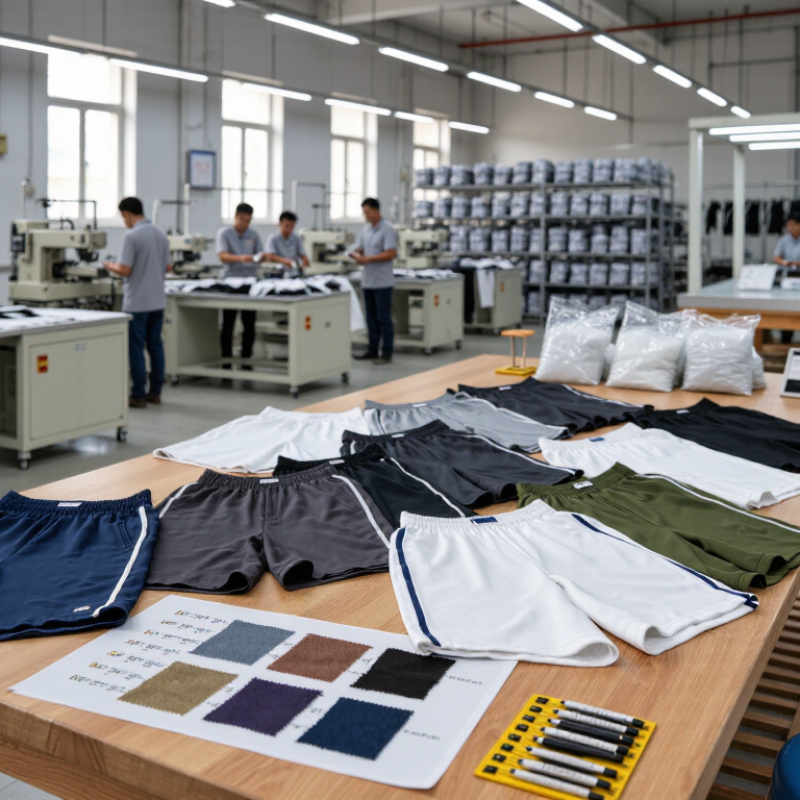
Quality depends on measurable details. A serious supplier should review the tech pack, confirm fabric weight, test shrinkage, and approve a physical sample. Waistband recovery matters after repeated washing. Stitch density matters around pockets.
I have seen attractive samples fail when bulk fabric changed. That risk is easy to underestimate.
Buyers should verify factory capacity, inspection records, packaging standards, and production timelines. Independent pre-shipment inspection adds practical confidence, especially for first orders. China’s 31% share is impressive, but export scale does not automatically prove every supplier’s consistency. Careful validation still matters.

Choosing a China white label shorts supplier requires more than comparing catalog prices. In factory screening, I check MOQ, monthly output, fabric sourcing, and quality records. A supplier quoting 300 pieces may suit a trial order. However, its production schedule may not support repeat volumes. Ask for line capacity, average lead time, and recent inspection evidence.
China’s 2023 textile and apparel exports reached approximately US$293.6 billion, according to China Customs data reported by the China National Textile and Apparel Council. Clothing exports contributed about US$159.1 billion, while textile exports reached nearly US$134.5 billion. These figures show strong manufacturing depth, but they do not prove every supplier is reliable. Scale can hide inconsistency.
Check the details. Request a size-set sample, fabric composition report, shrinkage results, and carton measurements. For capacity, compare declared monthly output with cutting tables, sewing lines, and worker shifts. A factory claiming 100,000 pairs monthly should explain its equipment and staffing. Numbers alone are weak.
MOQ needs careful negotiation. Smaller quantities can increase unit costs and reduce fabric choices. Larger orders may improve pricing but expose buyers to unsold inventory. I would begin with a controlled production run and record defects by size, color, and seam location. This feels slower. It often reveals problems that polished samples conceal.
For global buyers seeking a reliable white label shorts supplier, quality control must begin before bulk production. Our process checks fabric weight, color consistency, stitching strength, waistband recovery, and finished measurements. Small details matter. A loose thread or uneven hem can damage an entire shipment’s value.
We use AQL 2.5 as a practical acceptance level for final inspections. Inspectors review randomly selected cartons, not only the best-looking pieces. They record major and minor defects, measurement deviations, stains, holes, and labeling errors. Each inspection report includes photographs, sample quantities, and corrective actions. This creates traceable evidence for buyers and production teams.
Care labels follow the principles of ISO 3758, with washing, drying, and ironing instructions matched to the garment’s tested behavior. Selected materials can also undergo AATCC testing for colorfastness, dimensional change, pilling, and fabric performance. Test results help confirm whether shorts can withstand repeated consumer washing. No inspection system is perfect. Sampling can miss an isolated defect, and fabric behavior may change between lots. We therefore compare pre-production samples, in-line findings, and final reports before approving shipment. This cautious approach supports consistent sizing and dependable performance across international orders.
AQL 2.5 sampling reference based on ISO 2859-1, General Inspection Level II, normal single sampling.
The chart shows sample sizes and the corresponding acceptance and rejection numbers for different lot sizes.
This standard defines care-labeling symbols for washing, bleaching, drying, ironing, and professional textile care.
AATCC methods can be used for colorfastness, laundering performance, dimensional change, and appearance evaluation.
For global buyers, a white label shorts supplier must treat compliance as a production process, not a final inspection. REACH controls restricted chemicals in EU-market products, including dyes, prints, trims, and elastic components. ECHA’s enforcement work has repeatedly found restricted substances in consumer products, showing that paperwork alone is insufficient. Textile Exchange reported global fiber production reached about 124 million tonnes in 2023. Larger production volumes also increase chemical traceability risks.
In the United States, 16 CFR 1610 requires clothing textiles to meet flammability standards, with limited exemptions. Children’s shorts may also require CPSIA testing for lead, phthalates, tracking labels, and a Children’s Product Certificate. Labeling must match the destination market. Buyers should verify fiber content, country of origin, care instructions, and responsible company details. A laboratory pass is not permanent proof. Fabric composition, dye lots, and trims can change quietly between orders.
Tips: Request a bill of materials before sampling. Test the finished shorts, not only the raw fabric. Ask for REACH screening records and an accredited 16 CFR 1610 report. Keep sealed production samples for comparison. Check every label against the commercial invoice and packing list. Small errors, such as missing care symbols or inconsistent fiber percentages, can delay customs clearance. Suppliers should also document subcontractors, because an unknown printing or washing facility can weaken an otherwise reliable compliance file.
For global buyers, the best white label shorts supplier is not always the lowest FOB quote. Landed cost matters more. Under Incoterms 2020, FOB requires the supplier to clear export goods and load them onboard. The buyer usually pays ocean freight, insurance, import duty, customs fees, and inland delivery. A 3.80-dollar pair can exceed 6 dollars after delivery. Check every charge.
Use a simple worksheet. Add product price, origin fees, freight, duty, brokerage, inspection, and warehouse delivery. The World Bank’s Logistics Performance Index 2023 shows that customs reliability and shipment tracking strongly affect supply-chain performance. UNCTAD’s Review of Maritime Transport 2024 also documented longer shipping routes and greater freight volatility. That matters when booking seasonal shorts. Lead times should include fabric approval, sample corrections, production, inspection, and port waiting. A practical estimate may be 45 to 70 days, but congestion can extend it.
MOQ needs equal attention. A 1,000-piece MOQ may look flexible, yet smaller production runs can raise fabric waste and unit costs. Ask for size and color breakdowns. Also request a written quotation valid for a defined period. My experience is that missing carton dimensions often distort freight estimates. It is an easy mistake. Verify HS classification and local duty rates through official customs sources or the International Trade Centre’s Trade Map. Then compare suppliers using the same shipping term, quantity, delivery location, and quality standard. That comparison is slower, but far more reliable.