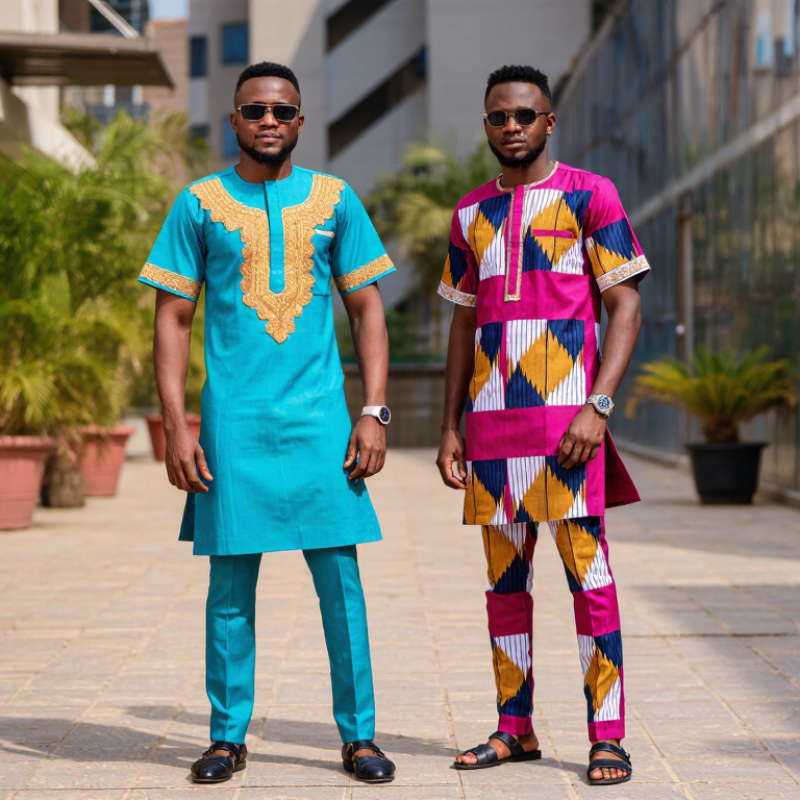
African Dashiki Suits are more than coordinated clothing. They bring together a distinctive tunic, matching trousers, and bold patterned fabric. Depending on the maker, a suit may feature a crisp collar, embroidered neckline, or vivid geometric print. The details vary. That variation matters: “dashiki” does not describe one fixed cut or textile, and styles reflect different makers, occasions, and personal choices.
Reliable market figures specifically for African Dashiki Suits are difficult to verify. UNESCO’s 2022 report Re|Shaping Policies for Creativity estimates that cultural and creative industries account for 3.1% of global GDP and 6.2% of employment. These figures cover a broad sector, not dashiki sales alone. They offer context, not a market-size estimate. Fashion scholar Victoria L. Rovine, author of African Fashion, Global Style, provides a useful lens on African dress and its global circulation. UNESCO Director-General Audrey Azoulay has described culture as “a global public good.” No verified, dashiki-specific quotation from Rovine or another specialist is available here, so attributing one would risk misleading readers. A closer look at the garments themselves is more useful: examine the fabric’s weight, the stitching around the neckline, and how comfortably the jacket and trousers move together. Bright prints can draw the eye. Fit and finish deserve equal attention.
What Are African Dashiki Suits?
A dashiki suit usually pairs a loose, brightly patterned tunic with matching trousers. The tunic often has a wide neckline, side slits, and embroidered or printed detail around the chest. Some sets include a cap or a longer jacket-style top. There is no single standard cut. Fabric, decoration, and fit vary by maker and region.
Dashiki clothing is associated with West African dress, while the word is commonly linked to the Yoruba term dansiki. The style also gained wider visibility during the 1960s, when it became a meaningful expression of African identity and pride. Today, people wear dashiki suits for celebrations, cultural gatherings, and everyday occasions. Meanings differ from person to person. Treating every design as interchangeable can overlook that difference.
Tips: Check the fabric weight and trouser length before choosing a set. A roomy top should still allow easy movement. Ask about a pattern’s origin when it matters to your occasion; its story may be more specific than it first appears.
Garment components in a common dashiki ensemble
A common dashiki suit pairs a loose, often decorated tunic with trousers. A cap may be worn as an accessory, but it is not required. The chart counts the examples shown, not how frequently each item is worn. Dashiki styles have roots in West African dress and are also worn across the African diaspora.
Dashiki suits are known for their loose cut and vivid patterns, but the fabric does not come from one single printing tradition. Some cloth uses wax-resist dyeing; other designs are screen-printed or made with industrial rollers. The method can affect the pattern’s edges, color depth, and feel.
In wax-resist work, a design is applied to cloth with wax before dyeing. The wax blocks color from reaching covered areas. After the fabric is dyed, the wax is removed, revealing the pattern. Repeated dyeing can create layered colors, while small cracks in the wax may let dye seep through. These marks are not always flaws. They can give the cloth a lively, irregular look. Not every dashiki print is wax-resist, though, and production methods differ by maker and region. It takes patience.
Tips: Check the fabric’s reverse side and seams for clues. Hand-dyed areas may show slight shifts in shade, while machine printing often looks more uniform. Ask how the cloth was made when its process matters to you. A label alone may not tell the whole story.
| Topic | Description or Technique | How It Works | Typical Result or Use |
|---|---|---|---|
| Dashiki suit | A coordinated outfit commonly consisting of a loose tunic and matching or complementary trousers. | The tunic may have a wide neckline, decorative embroidery, and a relaxed fit. Styles vary by maker, region, and occasion. | Worn for everyday use, celebrations, cultural events, and formal occasions, depending on the design and fabric. |
| Dashiki garment style | “Dashiki” describes a garment style; it does not identify one specific fabric, print, or textile-making method. | Dashiki garments can be made from printed cotton, plain woven cloth, embroidered fabric, or other suitable textiles. | The same silhouette can therefore have very different patterns, textures, and levels of decoration. |
| Wax-resist dyeing | A resist-dye process in which wax is applied to cloth before dyeing. | Waxed areas resist the dye. After dyeing, the wax is removed, revealing areas with a different color. Repeating the process with additional colors can build layered designs. | Crackle-like lines and irregular details may form where the wax cracks or the dye travels through the cloth. |
| Hand-stamped or block-resist work | A pattern is applied with a carved block or stamp, sometimes using a resist paste or dye. | The block is pressed onto the fabric repeatedly to create a motif or a larger repeating composition. The exact process depends on the materials used. | Small variations in alignment, pressure, and color can give handmade patterns a distinctive character. |
| Screen printing | Color is transferred through a mesh screen onto selected parts of the fabric. | A stencil blocks some areas of the screen while printing paste passes through open areas. Separate screens are commonly used for different colors. | Produces clear, repeatable motifs and can be used for both short runs and larger production. |
| Roller or rotary printing | An industrial method for printing repeating designs across long lengths of fabric. | Engraved rollers or rotary screens apply color in a continuous process. Different colors or design elements may be printed in separate passes. | Efficient for large quantities and consistent repeats; the appearance depends on the design and printing setup. |
| Printed “wax-style” cloth | Some commercial fabrics imitate the appearance of wax-resist prints without using a traditional hand-applied wax process. | Designs may be printed mechanically to create characteristic color contrasts, outlines, or crackle-like effects. | A wax-like look alone does not establish how a fabric was made; the production method varies between textiles. |
| Embroidery | Decorative stitching added to the fabric, often around a neckline, chest panel, or garment edge. | Thread is stitched by hand or machine onto the cloth. Embroidery decorates the garment rather than creating its base printed pattern. | Adds texture and emphasis, and is often used to highlight the front or neckline of a dashiki tunic. |
| Choosing fabric for a suit | Fabric weight, breathability, drape, colorfastness, and care requirements all affect how a suit feels and wears. | Lightweight cotton is often comfortable in warm weather; the garment’s cut and lining also influence comfort and movement. | Check the fabric label and care instructions, since printing and dyeing methods can require different washing practices. |
Dashiki suits may use cotton, cotton blends, or other woven fabrics, depending on the desired weight and drape. For a suit worn in warm weather, a breathable fabric can feel more comfortable than a dense, heavy weave. The name “Dashiki” describes a style, not a required fiber content. Check the garment label.
USDA classifies extra-long-staple cotton as cotton with fibers at least 1 3/8 inches long, or about 34.9 mm. This measurement is called staple length. It describes the average length of individual cotton fibers, not the width or thickness of the cloth. Longer fibers can be spun into smoother, stronger yarns, which may create a refined surface. But fiber length alone does not guarantee a durable suit. Weave, yarn quality, finishing, and sewing all matter.
Look closely. A firm fabric should hold its shape without feeling stiff, while seams should lie flat and secure. ELS cotton may be a useful quality detail, but it is not essential to every Dashiki suit. Some garments use shorter-staple cotton or blends for practical reasons, such as price or easy care. And labels can be vague. When fiber length is not stated, the fabric’s feel and construction still deserve attention.
Dashiki suits usually pair a relaxed tunic with matching trousers. The tunic may have a broad body, dropped shoulder, and decorative neckline, but cuts differ by maker. Measure the chest around its fullest point, the shoulder across the back, sleeve length from shoulder seam to wrist, and tunic length from shoulder to hem. Keep the tape level. Do not pull it tight. Fit is personal.
Choose a finished garment with enough ease for movement, not just a body measurement copied from a chart. For a comfortable tunic, check that you can reach forward without the chest pulling or the side seams twisting. Trousers need room at the seat and thigh, with the intended waistband position clearly specified. The CDC’s 2015–2018 anthropometric reference report gives average adult waist circumferences of 40.5 inches for men and 38.7 inches for women. Those population averages are not Dashiki size standards; they show why a single “standard” measurement can mislead. Compare your measurements with the seller’s garment measurements, and allow for fabric shrinkage when care instructions call for washing. Even careful measuring leaves some judgment. A chart can look precise, yet a slightly loose sleeve may feel better than a perfect number.
African Dashiki suits are recognized by their vivid motifs, often printed across matching tunics and trousers. Their saturated reds, blues, and golds make color retention a practical concern, especially at seams, cuffs, and areas rubbed by bags or chair backs. A fabric’s appearance alone cannot confirm its durability. Testing offers measurable evidence, though results describe specific test conditions rather than every day of wear.
The ISO 105 series contains separate methods for different exposures. ISO 105-C06 evaluates colorfastness to domestic or commercial laundering, while ISO 105-X12 addresses rubbing, including dry and wet crocking. ISO 105-A02 rates color change on a gray scale from 1 to 5; grade 5 indicates minimal change. ISO 105-A03 uses a similar 1-to-5 scale for staining on adjacent fabric. Light exposure is assessed separately under ISO 105-B02, using a blue-wool scale from 1 to 8. Different scales matter.
A useful laboratory report names the method, conditions, and result—not simply “passed.” For a Dashiki suit, buyers can compare wash and rubbing grades, then check whether the tested fabric matches the finished garment. A strong rating is reassuring, but it does not promise zero fading under every detergent, water temperature, or sunlight level. That distinction is easy to miss. Also, prints may fade unevenly; a small color shift can be more noticeable on a bold geometric pattern than on a plain fabric.