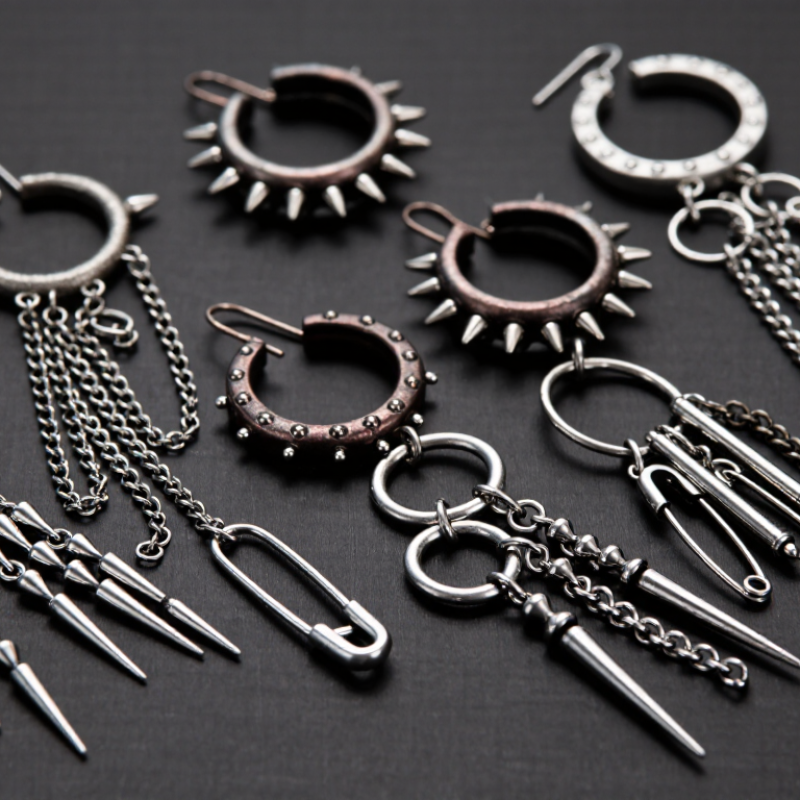
Punk Style Earrings turn small details into bold statements. A silver hoop with a dark finish can change an outfit; a studded drop can add edge without feeling heavy. For retailers, boutique owners, and designers, choosing a dependable manufacturer matters as much as choosing the right look. The product must feel comfortable, hold its finish, and arrive consistently. Those details are easy to overlook in a catalog photo.
This guide introduces ten China-based manufacturers and suppliers connected to punk-inspired earrings. It is designed as a starting point, not a final endorsement. Company capabilities, minimum order quantities, customization options, and export experience can change, so buyers should confirm current details directly. Ask for clear product specifications, material information, sample pricing, and production timelines. A close inspection of a sample may reveal rough edges, weak clasps, or colors that differ from the listing. Small issues matter.
The right partner depends on your collection. One business may suit custom designs, while another may focus on ready-made styles or larger orders. Compare communication, quality-control practices, packaging, and the way each supplier handles revisions. Requesting a sample is sensible. It is not a guarantee. Even a polished first sample may not represent every production batch, so clear written expectations can help prevent misunderstandings. This overview aims to make comparison more practical and highlight questions worth asking before placing an order.
A credible “top 10” list should compare evidence, not dramatic product photos. Grand View Research estimated the global jewelry market at USD 353.26 billion in 2023, with projected growth through 2030. That broad market figure does not measure punk earrings specifically, but it shows why consistent quality checks matter. For each Chinese manufacturer, assess product range, material specifications, sample consistency, production capacity, and export experience. Look for clear details on alloy composition, coating thickness, post materials, and earring weight. Ask whether the factory can reproduce a small, spiked design without rough edges or loose fittings. Those details are practical signals, not decoration.
Factory criteria deserve equal weight. Request recent audit records, documented inspection procedures, and examples of defect reporting. Compare quoted lead times with sample and bulk production schedules. A polished catalog proves little. One overlooked issue is whether custom finishes remain consistent across batches; even capable factories may struggle with small color variations. A fair ranking should explain its scoring method and distinguish verified factory data from sales claims.
Tips: Order samples in more than one finish, then inspect the posts, clasps, edges, and coating under bright light. Ask for written material declarations and a pre-shipment inspection option. If answers stay vague, lower the supplier’s score.
Choosing among China’s top 10 punk style earrings manufacturers takes more than comparing catalog photos. Ask for material specifications, such as the base metal, plating thickness, and nickel-release test reports. Request close-up photos of clasps, posts, and soldered joints. A polished finish can hide weak construction. Better to inspect a sample.
Verify production capacity with practical questions. How many pairs can the factory make per month, and what is the lead time for a repeat order? Ask whether it produces components in-house or relies on outside workshops. The answer may change during peak seasons, so request a written schedule and a sample production plan. Figures alone are not proof.
Clarify the minimum order quantity for each design, color, and packaging option. A low MOQ may apply only to standard items, not custom shapes or finishes. Check export experience through redacted shipping documents, destination-market references, and details about carton labeling and packing. These checks take time. I have found that buyers sometimes focus too much on price; I would also compare sample quality with the stated production process, since one sample cannot reveal every inconsistency.
Punk earrings rely on contrast: a matte black spike beside a bright steel hoop, or a small chain swinging from a chunky stud. Stainless steel offers a cool, weighty look and resists everyday tarnish better than many plated alloys. Brass is easier to shape and can develop a warmer tone, but its finish may wear faster. For lightweight statement pieces, zinc alloy allows intricate shapes, though buyers should inspect edges and coating consistency. Grand View Research estimated the global costume jewelry market at USD 34.3 billion in 2023, reflecting demand for expressive, accessible designs.
Finish changes both appearance and upkeep. Polished surfaces highlight sharp silhouettes; brushed or oxidized finishes soften reflections and make scratches less obvious. Black plating can create a strong punk effect, but color durability depends on the base metal, coating process, and wear conditions. Custom options often include stud size, chain length, enamel color, logo placement, and backing type. Ask manufacturers for material specifications and sample pieces. A photograph is not enough.
Tips: Request finish samples under daylight and indoor lighting. Check posts, clasps, and solder joints by hand. Small details matter. Customization can also increase minimum order quantities or lead times, so confirm these before approving production. One weak point remains: a dramatic design may feel uncomfortable after several hours. Test the weight on-ear, not just in a display tray.
For buyers comparing punk-style earrings, the finish is only part of the inspection. Sharp studs, chains, and dark coatings may look convincing under bright shop lights, but skin-contact safety deserves equal attention. Under the EU REACH nickel restriction, earrings inserted into pierced ears must release no more than 0.2 μg/cm²/week. Components intended for direct and prolonged skin contact generally have a limit of 0.5 μg/cm²/week. These are nickel release limits, not simply measurements of nickel content.
Ask manufacturers for recent test reports that identify the tested material, product type, and method. A report for a plain metal post may not cover a coated charm or a soldered joint. Check whether the tested sample matches the production item, too. Small changes matter. Wear, scratches, and repeated cleaning can affect coatings, though a single document may not show how every pair performs over time.
Good records help. Clear material declarations and batch traceability make follow-up easier if a supplier changes a component. I have seen product descriptions sound reassuring while leaving the test scope unclear. That gap is worth questioning. A neat finish is nice. Evidence is better. When selecting a manufacturer, treat nickel testing as one part of quality control, alongside secure fastenings and consistent workmanship.
Regulatory benchmarks for nickel release from products in contact with skin.
REACH Annex XVII sets a limit of 0.2 μg/cm²/week for post assemblies inserted into pierced ears or other pierced parts of the body, and 0.5 μg/cm²/week for articles intended to come into direct and prolonged contact with the skin. These are legal release limits, not measured results for specific products or manufacturers.
Choosing a punk-style earring supplier takes more than reviewing dramatic designs. Request material specifications for posts, hoops, clasps, and decorative parts. Ask which tests apply to the intended market, and request recent reports tied to the actual materials or finished products. A certificate alone may not prove every batch matches. Check sample workmanship closely: sharp edges, loose spikes, uneven plating, and clasps that open too easily are practical warning signs.
Tips: Compare the supplier’s sample with its written specifications. Ask for test documents, certification scope, and issuing dates. Confirm whether production changes require retesting. Keep one approved sample for later comparison. Small details matter.
Lead times should be stated in writing, including sample approval, production, inspection, and shipping estimates. Ask what happens if a component runs short or inspection finds defects. A clear answer is useful; a vague promise is not. After-sales support matters too. Agree on response times, evidence needed for a quality claim, and possible remedies before placing a large order. Even careful checks cannot prevent every mismatch. That is worth admitting. Start with a modest order, document conversations, and review the first delivery before scaling up.
This is a supplier-evaluation framework, not a ranked list of verified manufacturers. Lead-time figures are indicative planning ranges only; confirm actual schedules, applicable regulations, and test requirements for each product and destination market.
| No. | Due-Diligence Area | What to Verify | Evidence to Request | Testing or Compliance Reference | Planning Range / Checkpoint | After-Sales Questions |
|---|---|---|---|---|---|---|
| 01 | Business identity | Confirm the legal entity, registered business scope, operating address, and whether production is performed in-house or subcontracted. | Current business registration documents; production-site details; written disclosure of subcontractors involved in manufacturing or finishing. | Check registration details with the relevant official records. A business registration is not proof of product safety or quality. | Complete before sampling or payment; recheck the contracting entity on invoices and payment instructions. | Who is responsible for defects if a subcontractor performs plating, casting, or assembly? |
| 02 | Product and material scope | Identify the base metal, posts, backs, solder, coatings, stones, and any components that contact the ear or skin. | Material declaration and bill of materials for the exact style; confirmation that production materials match the approved sample. | Request testing against the rules applicable to the sales market and intended wearer. Requirements can differ for adult and children's products. | Complete before finalizing artwork, pricing, or purchase-order specifications. | How are material substitutions approved, recorded, and communicated before production? |
| 03 | Nickel release | Assess nickel release from posts and other parts intended for pierced ears, plus other parts with prolonged skin contact. | Recent laboratory report tied to the same materials, finish, and construction as the order; confirm report sample identification and test date. | EN 1811 is a reference test method for nickel release. For coated articles, EN 12472 may be used for simulated wear and corrosion before nickel-release testing. EU REACH limits depend on the article and use. | Test before bulk approval; repeat when materials, suppliers, or surface finishes change. | Who pays for retesting if a batch fails or the production finish differs from the tested sample? |
| 04 | Lead and other restricted substances | Check the metals, coatings, solder, and decorative components for substances restricted in the destination market. | Product-specific laboratory reports and a signed material declaration; reports should identify the tested components and methods. | Applicable limits vary by market and product category. In the United States, children's products have specific lead requirements; do not assume those rules apply identically to adult jewelry. | Confirm regulatory scope during product development and before shipment. | Can the supplier trace the affected lot and support corrective action if a test result is non-compliant? |
| 05 | Plating durability | Agree on coating type, color, finish, and acceptance criteria; inspect for uneven color, peeling, exposed base metal, and sharp edges. | Written finish specification; approved reference sample; coating or durability test reports where relevant. | There is no single universal plating-thickness requirement for all fashion earrings. Select suitable tests and acceptance limits for the coating, design, use, and market. | Approve a production-equivalent sample before placing the bulk order. | What remedy is offered for widespread tarnishing, peeling, or color inconsistency? |
| 06 | Mechanical and wear checks | Check post alignment, closure function, component attachment, stone setting, sharp points, and any detachable parts. | Sample inspection record with defect photographs; documented functional checks on representative finished pieces. | Use a risk-based product inspection plan. Children's products may require additional age-specific safety assessment and applicable small-parts evaluation. | Inspect samples before approval and finished goods before shipment. | Is there a documented process for investigating recurring breakage or loose components? |
| 07 | Quality system and audits | Review incoming-material controls, in-process checks, final inspection, defect records, and corrective-action procedures. | Quality-control checklist; recent audit summary if available; sample inspection report; corrective-action example with sensitive details removed. | ISO 9001 is a quality-management-system standard, not a product-safety certificate. Verify certificate scope, issuer, and validity if a supplier claims certification. | Review before order placement; define inspection frequency and acceptance criteria in the purchase order. | Will the supplier provide a corrective-action report and replacement or credit terms for confirmed defects? |
| 08 | Sampling and approvals | Ensure the approved sample matches the intended bulk product in dimensions, materials, color, finish, attachments, and packaging. | Signed or otherwise documented sample approval; dated photos and version-controlled specifications. | Laboratory reports should relate to the finished configuration being purchased, not merely a similar-looking item. | Indicative sample development: about 7–15 business days after specifications are complete; timing varies with tooling and material availability. | How are sample revisions, approval delays, and charges for additional samples handled? |
| 09 | Production lead time | Confirm the production start trigger, capacity allocation, material availability, inspection date, and shipping handover date. | Written production schedule with milestones; order confirmation stating quantities, tolerances, and delivery terms. | Lead time depends on design complexity, order quantity, components, finishing, and season. Do not treat an estimate as a delivery guarantee. | Indicative planning range: roughly 20–45 business days for production after sample approval and material confirmation; obtain a written order-specific commitment. | What notification and recovery plan apply if a milestone is missed? |
| 10 | Shipment and after-sales support | Agree on packaging, carton labeling, shipment documents, claim deadlines, and the process for shortages or quality problems. | Packing list; pre-shipment inspection record; agreed defect and shortage claim procedure; written warranty or remedy terms. | Confirm export and import documentation requirements with the chosen carrier, customs broker, and destination-market adviser. | Set the inspection and claim windows in the contract; allow additional time for freight and customs clearance. | Specify response time, evidence required, and whether remedies may include rework, replacement, credit, or refund. |